
Alere Determine™ TB LAM Ag
Evaluations
Independent Clinical Studies
Alere Determine™ TB LAM Ag
Below are summaries of a number of independent clinical studies of the Alere Determine™ TB LAM Ag. For more studies and links to papers please visit our Studies and Implementation map.

Massive diagnostic yield of HIV-associated tuberculosis using rapid urine assays in South Africa
Lawn SD*., Kerkhoff AD., Burton R., Schutz C., van Wyk G., Vogt M., Pahlana P., Nicol MP and Meintjes G. *Dept Clinical Research, Faculty of Infectious and Tropical Diseases, London School of Hygiene and Tropical Medicine, London UK
21st Conference on Retroviruses and Opportunistic Infections; 2014 Mar 3-6; Seattle, USA.
This observational study sought to identify improved methods for diagnosing tuberculosis (TB) in hospitalised HIV-infected patients. There is a huge burden of HIV-TB in this clinical population; autopsy studies demonstrate a high frequency of disseminated TB in HIV/AIDS in-patients in sub-Saharan Africa, indicating a failure of diagnosis.
Unselected HIV-infected medical admissions to a South African district hospital were investigated for TB. Sputum, urine and blood were systematically obtained within the first 24 hours. Additional respiratory and non-respiratory samples were collected according to clinical indication for culture. Sputum samples were tested using fluorescence microscopy, liquid culture and Xpert MTB/RIF. Urine samples were tested using Xpert (concentrated and unconcentrated urine) and Alere Determine TB LAM Ag. TB diagnosis was defined as MTB detected by Xpert or culture.
427 patients were included in the analysis. TB was diagnosed in 139 patients; the median CD4 count was 80 cells/μL. Symptoms were poorly predictive. Extra pulmonary TB was found in 83% of cases while pulmonary TB was found in just 54%.
Using samples obtained within the first 24 hours the proportions of final diagnoses made by the different diagnostic modalities was:
| Sputum microscopy | 19.4% |
| Sputum Xpert | 26.6% |
| Urine LAM | 38.1% |
| Urine Xpert | 59.0% |
TUsing the rapid urine tests together diagnosed 69.1% of cases. This was further increased to 80.6% when combined with sputum Xpert testing. Of those with CD4 < 100 cells/μL, 85.1% could be diagnosed with urine rapid tests alone.
The authors conclude that in the face of high TB prevalence (32.6%) and non-specific symptoms, routine microbiological screening for TB should be performed for all HIV-infected medical in-patients in high-burden settings. Adding urine-based testing to one sputum Xpert test increased the diagnostic yield 3-fold from 26.6% to 80.6%. Urine based rapid diagnostics should be considered for routine use in this patient population.
Diagnostic accuracy of a low-cost, urine antigen, point-of-care screening assay for HIV-associated pulmonary tuberculosis before antiretroviral therapy: a descriptive study.
Stephen D Lawn*, Andrew D Kerkhoff, Monica Vogt, Robin Wood.
Lancet Infect Dis. 2012 Mar;12(3):201-9.
* The Desmond Tutu HIV Centre, University of Cape Town, Cape Town, South Africa.
In this evaluation, Lawn et al assessed the diagnostic accuracy of the Alere Determine™ TB LAM Ag test for screening for HIV-associated pulmonary tuberculosis before antiretroviral therapy (ART).
Consecutive adults referred to an ART clinic in Gugulethu township, South Africa, were all screened for tuberculosis by obtaining sputum samples for fluorescence microscopy, automated liquid culture (gold-standard test), and Xpert® MTB/RIF assays and urine samples for the Clearview™ TB-ELISA and the Alere Determine™ TB LAM Ag test. Patients with M.tb cultured from one or more sputum samples were defined as cases of tuberculosis. The diagnostic accuracy of the Alere Determine™ TB LAM Ag test used alone or combined with sputum smear microscopy was compared with that of sputum culture and the Xpert® MTB/RIF assay for all patients and subgroups of patients stratified by CD4 cell count.
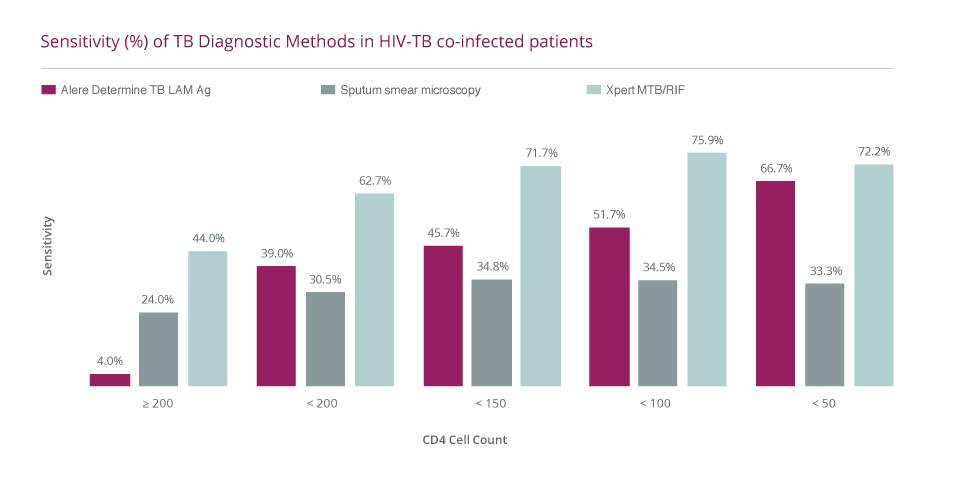
Complete results were available for 516 patients (median CD4 count 169.5 cells/µL). TB LAM had highest sensitivity at low CD4 cell counts and specificity was greater than 98% for all strata. Sensitivity was increased when combined with smear microscopy.
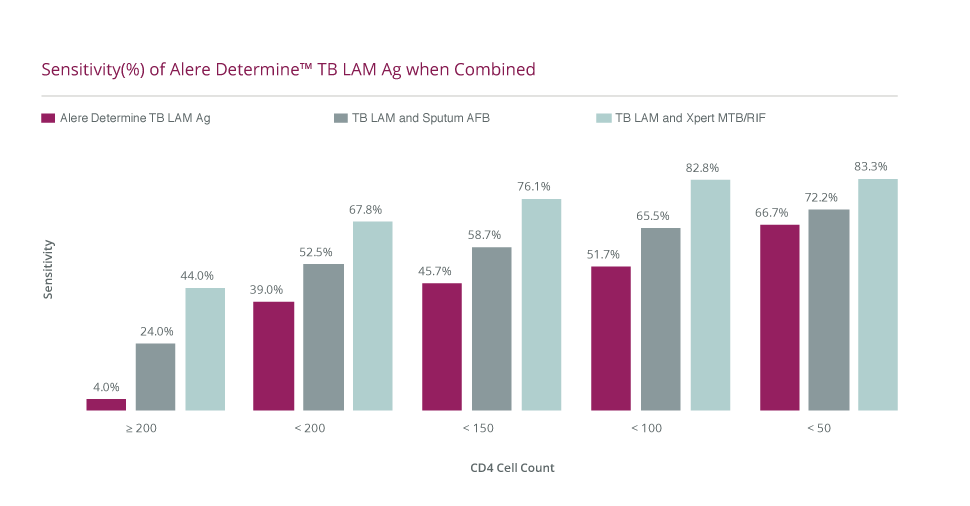
An important additive effect is seen when TB LAM Ag results are combined with smear microscopy, whereby sensitivity increases. In patients with CD4 cell counts of less than 100 cells/ µL and less than 50 cells/ µL, this combination was able to detect 65.5% and 72.2% of TB cases, respectively.
In this study, high sensitivity was demonstrated for patients with CD4 cell counts less than 100 cells/ µL when Xpert® MTB/RIF (one sample) and the TB LAM test were combined. This performance was greater than two sputum samples run on the Xpert MTB/RIF test.
The test also displayed a useful increase in sensitivity when used in combination with an abnormal chest radiograph, a positive WHO symptom screen or when a patient was categorised as having WHO Stage 3 or 4 disease.
The test provided results within 30 minutes and there was very high agreement between two independent readers of the strips.
The evaluation concluded that the Alere Determine™ TB LAM Ag rapid test was a simple, low-cost alternative to existing diagnostic assays for tuberculosis screening in HIV-infected patients with very low CD4 cell counts and provided important incremental yield when combined with sputum smear microscopy.
Diagnostic accuracy of a urine LAM strip-test for TB detection in HIV-infected hospitalized patients.
Jonathan G Peter*, Grant Theron, Richard van Zyl-Smit, Asheen Haripersad, Lynelle Mottay, Sarah Kraus, Anke Binder, Richard Meldau, Anneli Hardy, Keertan Dheda.
Eur Respir J. 2012 Feb 23. Epub ahead of print, doi:10.1183/09031936.00201711
*University of Cape Town, Cape Town, South Africa.
The Alere Determine™ TB LAM Ag test was evaluated in hospitalised HIV infected patients with suspected TB. In this prospective evaluation, a total of 423 adult patients were recruited and split into two groups: 1) 335 hospitalised individuals with suspected TB and HIV, and 2) 88 HIV infected hospitalised non-TB patients.
HIV infection was confirmed in 84% of group 1 patients; 48% of these patients were M.tb culture positive. An additional 71 patients were categorised as probable TB, using a composite reference standard that considered clinical treatment and two month follow up, and radiology findings in addition to results of smear and culture.
Findings
In this evaluation, the authors found that the TB LAM Ag test offers particular utility in a vulnerable population – HIV infected patients with advanced immunosuppression, patients who have high mortality and healthcare costs, and who are a diagnostic challenge.
In these patients the TB LAM Ag test potentially offers a rapid rule-in diagnosis, which could be used to guide rapid initiation of anti-TB therapy.
Advanced immunosuppression
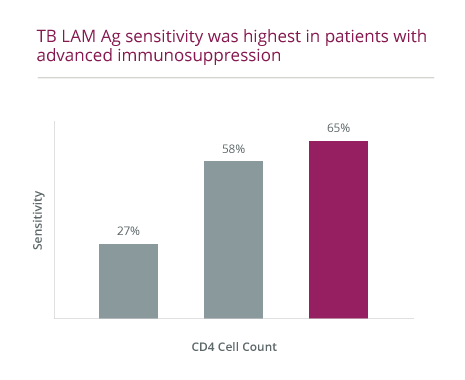
TB LAM Ag sensitivity was highest in patients with advanced immunosuppression.
Use TB LAM Ag in Combination
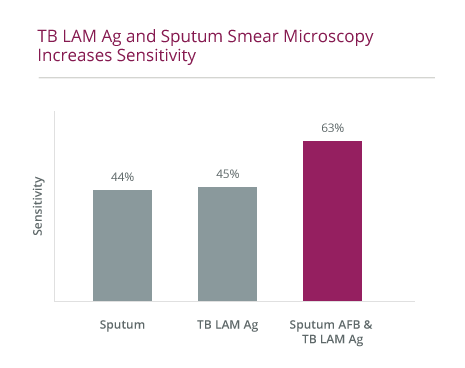
Combining smear microscopy and TB LAM Ag yielded greater performance than either test alone. In district hospitals in high burden TB-HIV settings with poor or no laboratory equipment, this combination offers significant clinical utility.
Useful for extrapulmonary TB
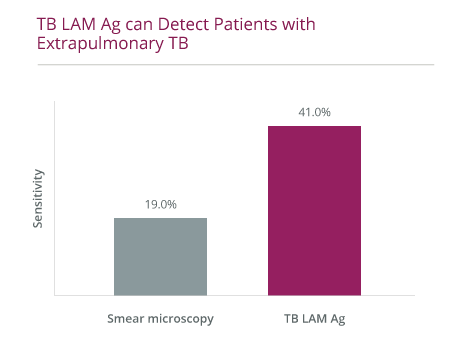
The test was useful in identifying patients with extrapulmonary TB, and was able to identify nearly half of these patients. This offers a great advantage for these patients who would otherwise require further investigation. Using a urine sample enables the test to detect both extrapulmonary and pulmonary tuberculosis and obviates the need for a biological sample from the site of disease. This may offer an advantage over other diagnostic formats such as the Xpert MTB/RIF assay.
In HIV-infected patients with advanced immunosuppression the TB LAM Ag test potentially offers a rapid rule-in diagnosis, which could be used to guide rapid initiation of anti-TB therapy.