
Alere Determine™ HIV-1/2 Ag/Ab Combo
Evaluations
Independent Clinical Studies
Alere Determine™ HIV-1/2 Ag/Ab Combo
Below are summaries of a number of independent clinical studies of the Alere Determine™ HIV-1/2 Ag/Ab Combo test. For more studies and links to papers please visit our Studies and Implementation map.
Explore More Studies on the Map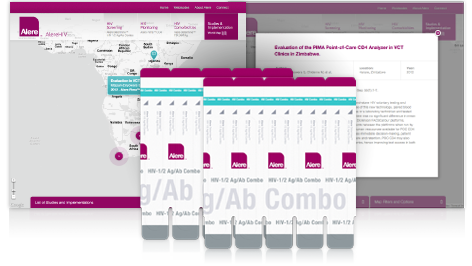

Performance of Rapid Point-of Care and Laboratory Tests for Acute and Established HIV Infection in San Francisco
Pilcher CD*, Louie B, Facente S, Keating S, Hackett J Jr, et al. *HIV/AIDS Division, University of California San Francisco ,San Francisco, California, United States of America
PLoS ONE (2013) 8(12): e80629. doi:10.1371/journal.pone.0080629
Given the recent advances in HIV testing, including 4th generation assays with ability to detect HIV earlier and HIV tests that can be self-administered at home, it’s important to get a better understanding of how these may perform. This study was designed to evaluate how well these newer tests (OraQuick Advance® (OQ), the Abbott Architect® HIV Ag/Ab Combo (AA) and the Alere Determine™ HIV-1/2 Ag/Ab Combo 4th Generation assay (Combo) performed versus other commonly used tests for the detection of HIV infection. The large (over 21,000 specimens) retrospective study looked at:
- Comparisons of OQ/AA & the Combo versus Ab-only tests in combination with nucleic acid amplification test (NAAT) for the detection of acute HIV infection
- A comparison of the performance of many commonly used lab-based and rapid HIV tests
To assess these newer tests, all specimens that had negative/discrepant antibody results on initial screening were reanalyzed with a rapid test followed by RNA testing, and those confirmed as positive were classified as acute or early HIV infection. Of these acute/early cases that had been missed by using the traditional tests, the AA antigen-antibody combo immunoassay was able to detect 87.4%; the Combo rapid test detected 54.4%; and the OQ 5.2%
To estimate how the new tests performed versus the tests used on the original samples, the number of newly identified samples from each test were added to the total of previously identified positives and a new ‘total cases identified’ estimate for each test was calculated. The potential for overall case detection (including acute and established HIV infection) was estimated at 99.1% for AA, 96.9% for Combo, and 92.8% for OQ (Table 1). A subset of patients screened for HIV using oral fluid samples were also tested by the OQ rapid test. Only 86.6% of HIV infections were detected, demonstrating a substantially lower sensitivity than any blood test.
The study concluded that oral fluid testing greatly reduces ability to detect HIV and that the new 4th generation combo tests can detect the majority of acute infections detectable by HIV RNA but with rapid results. Using these 4th generation tests as a primary screening assay in high-risk HIV testing programs could reduce or eliminate the need for HIV RNA testing.
View Paper OnlinePerformance of the Alere DetermineTM HIV-1/2 Ag/Ab Combo Rapid Test with specimens from HIV-1 seroconverters from the US and HIV-2 infected individuals from Ivory Coast.
Silvina Masciotra∗, Wei Luo, Ae S. Youngpairoj, M. Susan Kennedy, Susan Wells,Krystin Ambrose, Patrick Sprinkle, S. Michele Owen *Laboratory Branch, Division of HIV/AIDS Prevention, Centers for Disease Control and Prevention, Atlanta, GA, United States
J Clin Virol (2013) http://dx.doi.org/10.1016/j.jcv.2013.07.002
This study evaluates the ability of the Alere DetermineTM HIV-1/2 Ag/Ab Combo test to detect early HIV-1 infections and HIV-2 antibodies in well characterised plasma specimens. The study used serial plasma specimens (n=230) from 26 well characterised HIV-1 seroconversion plasma panels and specimens from HIV-2 groups A and B infected individuals from the Ivory Coast (n=86).
The Genetic SystemsTM HIV 1/2 plus O and HIV 1/2 Ag/Ab combo immunoassay (GS Combo) were used as comparator assays for the detection of antibody (Ab) (3rd generation IA) and antigen (Ag)/Ab (4th generation IA) detection respectively. Additionally all plasma specimens were also tested with COBAS Ampliprep/COBAS Taqman HIV-1 test v2.0 to allow for comparison between viral load values and p24 detection by Alere DetermineTM HIV-1/2 Ag/Ab Combo test.
Using 50% cumulative frequency estimates compared to previous estimates for FDA approved assays using the same specimen set, the Alere DetermineTM HIV-1/2 Ag/Ab Combo test reactivity was calculated to be 15.5 days before the first positive Western Blot (WB) (Fig. 1) and places the Alere DetermineTM HIV-1/2 Ag/Ab Combo test between 3rd and 4th generation immunoassays (IAs). The reaction of the Ab-only component of the test was 7 days before the first positive WB, which is comparable to FDA-approved flow through rapid tests.
The Alere DetermineTM HIV-1/2 Ag/Ab Combo test detected 124 (92.5%) of the 134 specimens detected by the GS Combo; 34 showed reactivity to the Ag line, 15 to both Ag and Ab lines and 75 to the Ab line only. However whilst the performance of the Alere DetermineTM HIV-1/2 Ag/Ab Combo test was significantly lower than 4th generation IA, 23 more specimens were detected by Alere DetermineTM HIV Combo than 3rd generation IA.
Moreover the Alere DetermineTM HIV-1/2 Ag/Ab Combo test was reactive for Ag in 22 of the 26 seroconversion panels with a median time of 7 days between the appearance of the Ag line and the Ab line. All of the 86 HIV-2 plasma specimens were Ab reactive by Alere DetermineTM HIV-1/2 Ag/Ab Combo, with the Ag line showing no reactivity.
The data showed that the Alere DetermineTM HIV-1/2 Ag/Ab Combo Ab component performs as well if not better than current FDA-approved rapid tests, with the Ag detection component conferring an advantage prior to seroconversion when p24 could also be detected. Correlations between viral load and the concentration of p24 estimated that Alere DetermineTM HIV-1/2 Ag/Ab Combo test detected p24 in the range of sensitivity between 11.9 and 33.5 pg/ml French National Standard.
Masciotra et al acknowledge that a possible short coming of the evaluation was that it was conducted using plasma samples and not whole blood, the specimen more likely to be used in a point of care setting. However the author concludes that the findings of the study indicates that the performance of the Alere DetermineTM HIV-1/2 Ag/Ab Combo test is as good if not better than current rapid tests on the US market for the detection of early HIV infection and could play a role in the prevention of HIV transmission in the US by facilitating early detection of HIV infection, improving receipt of results and early linkage to care.
View Paper OnlineA Clinical Study of Antigen-Antibody Rapid Testing for Acute HIV Infection.
Christopher D Pilcher*, Brian Louie, Sheila Keating, Mark Pandori, Falk Fish, Tomer Keren, Sally Liska, Michael P Busch, Frederick M Hecht, Jeffrey Klausner, Grant Colfax.
16th Conference on Retroviruses and Opportunistic Infections (CROI); 2009 Feb 8-11; Montreal, Canada. Poster #992.
* UCSF HIV/AIDS Division, USA.
This evaluation was undertaken in high-risk populations in San Francisco and sought to assess the potential impact of new fourth generation screening assays, including the Alere Determine™ HIV-1/2 Ag/Ab Combo on public health and research testing programs.
Programs chosen for the evaluation included those targeting high risk MSM, STD Clinic, Non-occupational Post Exposure Prophylaxis, Partner Services Testing and a UCSF study screening patients for having acute HIV. All programs used both HIV antibody (Ab) and HIV RNA tests in their diagnostic algorithms.
HIV infection was defined in patients by a complete algorithm including Ab and RNA testing. Western blot was used to categorise samples as acute or established infection. The performance parameters (sensitivity, specificity, Positive/Negative Predictive Values) of each screening assay were determined using this algorithm.
Samples identified as acute (RNA+, WB- or indeterminate) were run on the rapid tests under evaluation as well as central lab panel tests.
In the high risk MSM testing population, the Alere Determine™ HIV-1/2 Ag/Ab Combo demonstrated 96% sensitivity and 100% specificity, outperforming all other rapid assays evaluated. These included Unigold Recombigen, Multi-Spot HIV1/2, Oraquick Advance (blood and oral fluid) and Clearview Stat-Pak. The Alere Determine™ HIV-1/2 Ag/Ab Combo also identified 80 out of 81 HIV negative samples (specificity 98.9%).
In another analysis of samples that were RNA positive, the Alere Determine™ HIV-1/2 Ag/Ab Combo was able to detect the majority of these patients. In contrast, the majority of these patients were not detectable by the third generation tests also evaluated.
The authors conclude that the Alere Determine™ HIV-1/2 Ag/Ab Combo was able to increase detection of HIV infection compared to all existing antibody-only rapid tests. The speed and the simplicity of the test make it suitable for settings in both the developed and developing world.
Evaluation of a rapid and simple fourth-generation HIV screening assay for qualitative detection of HIV p24 antigen and/or antibodies to HIV-1 and HIV-2.
Beelaert G*, Fransen K
J Virol Methods. 2010 Sep;168(1-2):218-22.
* Dept Microbiology, Institute of Tropical Medicine, Antwerpen, BELGIUM.
A retrospective performance assessment was undertaken of the Alere Determine™ HIV-1/2 Ag/Ab Combo on characterised whole blood, serum or plasma specimens from patients diagnosed with HIV infection. In addition to assessing the performance of the Alere Determine™ HIV-1/2 Ag/Ab Combo, the authors sought to determine whether the test was suitable for use in resource constrained settings.
Nine panels were used in this assessment, using a combination of fresh and frozen anonymous samples. An HIV-1 p24 Ag standard from the National Institute for Biological Standards and Controls was also evaluated. The sensitivity of the test was assessed using five panels comprising a combination of HIV-1 subytped and HIV-2 positives, primary HIV infections and samples from patients in different stages of the disease. The test’s specificity was assessed using panels from confirmed non-HIV infected patients.
Antibody sensitivity was found to be 100% with all fresh and archived HIV-1 Ab-positive samples, HIV-2 Ab-positive samples and the Ab-positive subtyped samples (189 in total). No differences were seen between whole blood, serum or plasma samples.
Antigen sensitivity was evaluated on 57 samples classified as primary HIV infection (PHI) and 10 seroconversion pairs. 39 of the PHI samples were reactive only for HIV-1 p24 antigen. Of these, the Alere Determine™ Combo detected 32. The additional 18 PHI samples were Ag and Ab reactive; the Alere Determine™ HIV-1/2 Ag/Ab Combo detected 17 of these samples. In total, the Alere Determine™ HIV-1/2 Ag/Ab Combo detected 42 of the 57 PHI samples, yielding sensitivity of 86%.
Antigen sensitivity was further assessed on a panel of 10 seroconversion samples. The Alere Determine™ Combo missed just one first blood sample and detected all post-seroconversion samples.
The specificity of the Alere Determine™ HIV-1/2 Ag/Ab Combo test was 100% when assessed on 200 archived and fresh HIV negative samples.
The authors conclude that the Alere Determine™ HIV-1/2 Ag/Ab Combo test exhibits high specificity, excellent ability to detect Ab and demonstrates good sensitivity for detecting early HIV infections. It is suitable for use in resource constrained settings and in remote areas where infrastructure is lacking. In such settings this test could be an important tool for expanding access to sensitive testing.
View Paper Online